Urban planners, construction managers, and real estate developers face a common challenge: accurately identifying and measuring buildings from aerial imagery. Traditional methods require hours of manual tracing and analysis. Today, AI-powered building segmentation is changing the game.
What is AI Building Segmentation?
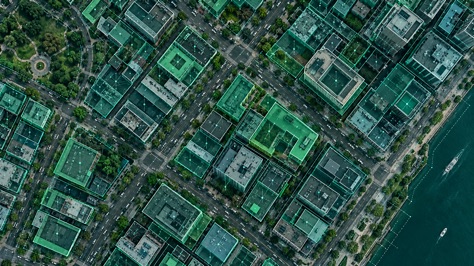
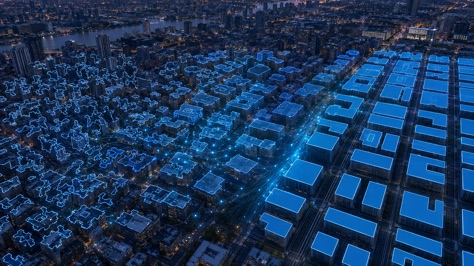
Building segmentation is the process of automatically identifying and outlining building boundaries in images. Using deep learning algorithms, AI can analyze drone imagery, satellite photos, and orthophotos to detect structures with remarkable precision.
Unlike traditional computer vision techniques, modern AI segmentation models:
- Process images in seconds instead of hours
- Achieve 95%+ accuracy in building detection
- Handle complex urban environments with overlapping structures
- Work with various image sources including drones, satellites, and aerial surveys
Why Drone Imagery is the Perfect Data Source
Drone technology has transformed data collection for urban planning. Here's why drone imagery is ideal for AI building segmentation:
Higher Resolution
Drone imagery provides resolution down to 2-5cm per pixel, compared to 30cm+ for commercial satellites. This level of detail allows AI to detect small structures, roof features, and building boundaries with exceptional clarity.
On-Demand Data Collection
Unlike satellite passes scheduled weeks in advance, drones can capture imagery whenever needed. Construction teams can monitor progress weekly, and urban planners can document changes in real-time.
Cost-Effective at Scale
For areas under 100 square kilometers, drone surveys are significantly more cost-effective than satellite imagery or manned aerial photography. Combined with automated AI analysis, the cost per building analyzed drops by 80-90%.
Real-World Applications
Urban Planning
City planners use AI building segmentation to:
- Create accurate building inventories
- Monitor urban growth and sprawl
- Assess density and zoning compliance
- Plan infrastructure improvements
Construction Monitoring
Construction teams leverage the technology for:
- Progress tracking against BIM models
- As-built documentation
- Site analysis and earthwork calculations
- Safety compliance verification
Real Estate Development
Developers apply building segmentation to:
- Evaluate potential development sites
- Analyze competitive landscapes
- Assess property values based on surrounding structures
- Plan new developments with accurate context
Disaster Response
Emergency management teams use AI segmentation for:
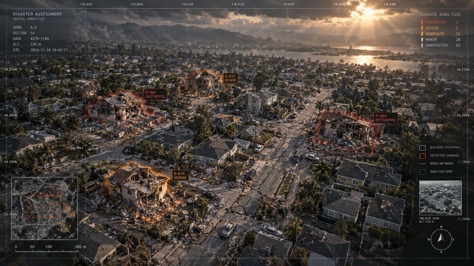
- Rapid damage assessment after natural disasters
- Identifying destroyed or damaged buildings
- Coordinating relief efforts with accurate building counts
How AI Building Detection Works
The technology behind modern building segmentation uses convolutional neural networks (CNNs), specifically architectures like U-Net and Mask R-CNN. Here's the simplified process:
This technology is part of a broader field called orthophoto analysis, which compares traditional and AI-powered approaches to aerial imagery interpretation.
- Image Input: The system receives drone imagery or orthophotos
- Feature Extraction: The AI identifies edges, textures, and patterns characteristic of buildings
- Segmentation: Each pixel is classified as "building" or "non-building"
- Post-Processing: Results are refined to create clean, usable boundaries
- Output Generation: Vector files, measurements, and analytics are produced
Choosing the Right Building Segmentation Solution
When evaluating AI building detection tools, consider these factors:
| Feature | Why It Matters |
|---|---|
| Accuracy Rate | Look for 90%+ precision and recall rates |
| Processing Speed | Should handle large orthophotos in minutes, not hours |
| Output Formats | GeoJSON, Shapefile, and DXF support for GIS integration |
| Orthophoto Support | Ability to process large-scale, georeferenced imagery |
| API Access | For integrating into existing workflows |
Getting Started with AI Building Segmentation
Ready to transform your workflow? Here's how to begin:
- Collect Quality Imagery: Ensure your drone imagery has sufficient overlap (70% front, 60% side) for accurate orthophoto generation
- Prepare Your Data: Process drone images into orthophotos using photogrammetry software like Pix4D or Agisoft Metashape
- Choose Your Tool: Select an AI segmentation platform that supports your file formats and integration needs
- Upload and Process: Submit your orthophotos for AI analysis
- Review and Export: Verify results and export building boundaries in your preferred format
The Future of Building Analysis
AI building segmentation is rapidly evolving. Emerging capabilities include:
- 3D Building Reconstruction: Automatically generating 3D models from segmented buildings
- Change Detection: Automatically identifying new construction or demolished structures
- Attribute Extraction: Determining building height, roof type, and construction material
- Solar Potential Analysis: Calculating rooftop solar capacity from segmented buildings
Conclusion
Wondering about the business case? See complete ROI analysis: AI vs Manual Detection Costs
AI-powered building segmentation is no longer experimental—it's a practical tool delivering real results for urban planners, construction teams, and real estate professionals. By automating the tedious work of building detection, professionals can focus on analysis, decision-making, and delivering value to their clients.
Whether you're managing a construction project, planning urban development, or analyzing real estate opportunities, AI building segmentation can save time, reduce costs, and improve accuracy.
Ready to Experience AI Building Segmentation?
Try WetuneAI for free and see how our advanced AI can transform your drone imagery into actionable building insights.
Try It for Free →Frequently Asked Questions
What types of imagery work best for AI building segmentation?
High-resolution drone imagery and orthophotos work best. The AI can process images with ground sample distances (GSD) of 2-10cm per pixel for optimal results.
How accurate is AI building detection?
Modern AI models achieve 95%+ accuracy in building detection and segmentation, depending on image quality and urban complexity.
Can AI handle dense urban environments?
Yes, advanced segmentation models can accurately identify individual buildings even in dense urban areas with closely packed structures.
What file formats can I export?
Most platforms support GeoJSON, Shapefile, DXF, and KML exports for easy integration with GIS software like ArcGIS and QGIS.
How long does processing take?
Processing time depends on image size, but most AI platforms can analyze large orthophotos covering several square kilometers in 5-15 minutes.