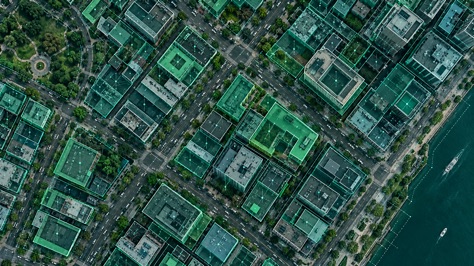
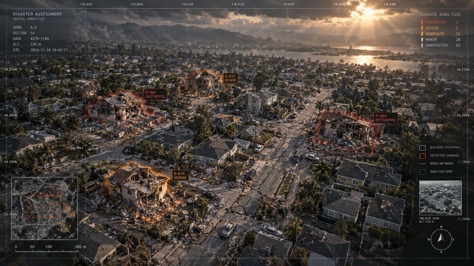
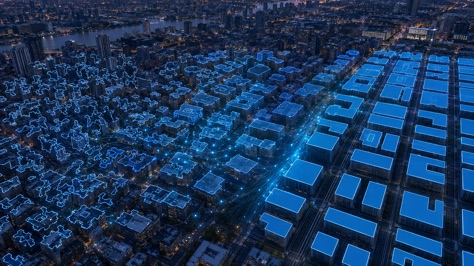
In May 2026, the smart city conversation reached a turning point. NVIDIA showcased AI agents autonomously managing urban operations inside Omniverse digital twins. The United Nations hosted its first Virtual Worlds Day, highlighting how AI and digital twin technologies are reshaping urban governance. Dubai announced the completion of mobile mapping surveys across its waterways for integration into a city-scale digital twin. Vietnam committed to nationwide AI-powered smart city development built on digital twin foundations.
The headlines are exciting. But zoom past the press releases and a quieter story emerges—one about data infrastructure. Because for all the sophistication of real-time simulation engines and AI agents, every urban digital twin stands on a surprisingly humble foundation: an accurate map of every building in the city.
What's Driving the Digital Twin Revolution Right Now
Three converging forces are accelerating digital twin adoption in 2026.
First, compute costs have dropped dramatically. Training and running the models needed for city-scale simulation no longer requires a supercomputer. Cloud GPU instances and edge computing now make real-time urban modeling accessible to mid-sized municipalities, not just national governments and tech giants.
Second, AI agents are graduating from demos to deployment. NVIDIA's Omniverse Blueprint framework now supports autonomous AI agents that can simulate traffic patterns, predict energy demand, and optimize emergency response routes—all inside a digital twin. These agents need accurate spatial context to function. A traffic optimization agent that doesn't know building footprints can't model pedestrian flow. An energy demand agent that can't estimate building volumes can't forecast consumption.
Third, the economics have shifted. The Australia Digital Twin Market alone is projected to reach $5.7 billion. Cities are discovering that the upfront investment in digital infrastructure pays for itself through operational efficiencies, better disaster preparedness, and more accurate infrastructure planning. The Deloitte 2026 Engineering and Construction Outlook identifies digital twins as one of the top five trends reshaping the built environment.
The Foundation Problem: Every Digital Twin Starts with Buildings
Here's a question that separates ambitious smart city announcements from operational reality: how do you actually build the geometry layer of a city digital twin?
A functional urban digital twin needs to know the exact location, footprint, height, and shape of every structure in the city—from skyscrapers to single-family homes, from warehouses to bus shelters. This isn't just for visual appeal. Building geometry is the input variable for nearly every urban simulation: solar potential analysis, flood risk modeling, population density estimation, emergency evacuation routing, telecommunications line-of-sight planning, and tax assessment.
Traditionally, creating this building layer meant manual digitization. Teams of GIS technicians would trace building outlines from satellite imagery, one polygon at a time. For a mid-sized city with 50,000 structures, this could take months. For a megacity like Jakarta or Mexico City with millions of buildings, the timeline stretches into years—assuming consistent funding and staffing.
This is the bottleneck that AI-powered building detection eliminates. Instead of manual tracing, modern vertical AI models can automatically extract building footprints from drone imagery and orthophotos in hours—not months—with accuracy rates exceeding 95%. The output is a clean, georeferenced polygon dataset ready for ingestion into any digital twin platform.
From Drone to Digital Twin: The Building Detection Pipeline
Understanding how AI building detection feeds into digital twins helps explain why domain-specific models outperform general-purpose alternatives.
Step 1: Image Acquisition
The pipeline begins with high-resolution aerial imagery. Modern drones capture orthophotos with ground sample distances (GSD) of 2–10 cm per pixel—sharp enough to distinguish individual roof tiles. For city-scale projects, fixed-wing drones or manned aircraft can cover hundreds of square kilometers in a single flight. Satellite imagery provides an alternative for regions where drone flights are impractical, though lower resolution typically yields slightly reduced accuracy.
Step 2: AI-Powered Detection and Segmentation
This is where vertical AI proves its value. A general-purpose vision model might identify "a building" in an image. A domain-specific building detection model identifies much more: the precise building footprint polygon, the estimated height based on shadow analysis, the roof type (flat, gabled, hipped), and even construction material cues from spectral signatures. These models are trained on millions of labeled building instances across diverse urban morphologies—from European medieval cores to American suburban sprawl to Asian high-density tower clusters.
The difference in accuracy is significant. General-purpose models operating in zero-shot mode on building detection tasks typically achieve 70–80% accuracy. Vertical models trained specifically for this task exceed 95%. For a city of 100,000 buildings, that gap represents 15,000–25,000 buildings that would need manual correction—completely undermining the efficiency case for automation.
Step 3: Geospatial Output
The detected buildings are exported as standard GIS formats—GeoJSON, Shapefile, or GeoPackage—with attribute tables containing footprint area, perimeter, estimated height, and roof classification. These formats integrate directly with ArcGIS, QGIS, and digital twin platforms including NVIDIA Omniverse, Unreal Engine with Cesium, and Esri CityEngine. The data flows seamlessly into existing municipal GIS workflows without requiring proprietary converters.
Step 4: Digital Twin Integration
The building layer becomes the spatial backbone of the digital twin. Other data layers—transportation networks, utility infrastructure, vegetation, water bodies—are registered against it. AI agents use building geometry to compute sightlines for telecommunications planning, shadow casting for solar potential, and volume estimates for energy demand forecasting. The building footprints are no longer just polygons on a map; they're computational primitives that power an entire ecosystem of urban analysis.
Case in Point: How Cities Are Using AI Building Data Today
The gap between theory and practice is closing rapidly. Here are three real-world patterns emerging in 2026.
Disaster preparedness and response. When Hawaii experienced severe flooding from the March 2026 Kona Low storm system, emergency responders needed rapid building-level damage assessments. Washington state's mapping technology—powered by automated feature extraction—accelerated infrastructure recovery during December floods, demonstrating that pre-existing building datasets make post-disaster response dramatically faster. Cities with digital twins containing accurate building footprints can run flood simulation models within hours of a forecast, identifying which structures are at risk before water arrives.
Renewable energy planning. As countries push toward 100% renewable electricity targets, building-scale solar potential analysis has become critical. AI-detected building footprints with roof type classification allow planners to compute total rooftop solar capacity across entire cities. A digital twin with accurate building geometry can answer questions like "which neighborhoods could generate enough rooftop solar to offset their consumption?"—questions that are impossible to answer without building-level data.
Urban growth monitoring. Cities in rapidly urbanizing regions—particularly across Southeast Asia and Africa—use periodic drone surveys combined with AI building detection to track construction activity, detect unauthorized development, and update municipal tax rolls. The Andhra Pradesh model in India demonstrates how AI-powered spatial governance, built on automated feature extraction from satellite imagery, is transforming land administration at the state level.
Beyond Visualization: AI Agents and Autonomous Urban Operations
The most transformative aspect of digital twins in 2026 isn't visualization—it's autonomous operation. NVIDIA's Omniverse AI agents represent a paradigm shift: rather than humans querying a digital twin for insights, AI agents continuously monitor and optimize urban systems.
Consider a traffic management agent. It doesn't just display congestion on a map. It reroutes autonomous shuttles, adjusts traffic signal timing, and notifies emergency vehicles of optimal routes—all in real time, all based on the spatial model of the city. But here's the dependency chain: the agent's routing algorithm requires accurate street geometry, which depends on accurate building footprints, which define where streets actually are.
The same pattern holds for energy grid agents (which need building volumes to forecast demand), water management agents (which need impervious surface calculations based on building footprints), and public safety agents (which need accurate address-to-coordinate mapping for emergency dispatch). Building detection is not just a data layer—it's a dependency for every downstream AI agent in the urban stack.
This is why the quality of the building detection layer matters disproportionately. A 5% error in building footprints cascades into errors in every simulation, every forecast, and every autonomous decision that depends on spatial context. The margin for error shrinks as the autonomy level increases.
Getting Started: Building Your City's Digital Foundation
For GIS professionals, urban planners, and municipal technology leaders, the path to a functional urban digital twin starts with three practical steps.
1. Audit your existing building data. Most cities already have some form of building footprint dataset—cadastral maps, tax parcel data, or legacy GIS layers. The question is accuracy, completeness, and currency. If your building data is more than three years old, it's almost certainly missing recent construction. If it was manually digitized, it almost certainly contains inconsistencies. Run a pilot: compare 1,000 buildings from your existing dataset against a fresh AI detection pass. The gap will tell you whether your foundation is solid.
2. Commission a drone survey of a pilot zone. Select a 5–10 square kilometer area that represents your city's typical urban morphology. A drone survey at 5 cm/pixel GSD costs a fraction of what manual digitization would, and the resulting orthophoto can be processed through AI building detection in hours. The output is a ground-truth dataset you can use to calibrate expectations for city-scale deployment.
3. Choose AI that understands buildings, not just pixels. General-purpose vision AI produces general-purpose results. For building detection—where a missing garage or a merged rowhouse has real-world consequences—vertical AI trained specifically on architectural and urban patterns delivers the accuracy that digital twin applications demand. The model needs to understand that a pitched roof with dormers is a single building, not three; that a courtyard building is one polygon with a hole, not four separate structures; that a high-rise casts a long shadow that doesn't represent additional buildings.
The smart cities of 2026 aren't built on marketing decks. They're built on data—and the most fundamental data layer is the one that answers the question: where are the buildings? Get that right, and everything else follows.
See AI Building Detection in Action
Upload a drone image or orthophoto and watch WetuneAI automatically detect and segment every building. Free to try, no registration required.
Try it for Free →