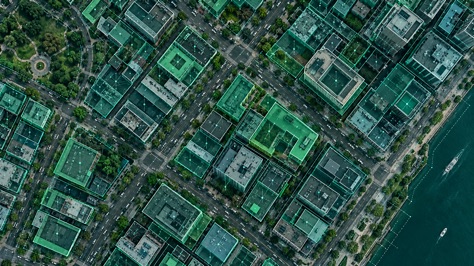
The construction and urban planning industries are experiencing a technological renaissance. As cities grow more complex and the demand for sustainable development intensifies, professionals need tools that can keep pace with increasing workloads. Enter AI-powered building detection—a technology that's transforming how we analyze the built environment.
The Efficiency Challenge in Traditional Workflows
For decades, urban planners and architects have relied on manual methods to analyze building footprints, assess construction progress, and plan new developments. These traditional approaches, while thorough, come with significant limitations:
- Time-intensive processes: Manual analysis of drone imagery or orthophotos can take weeks for large-scale projects
- Open Buildings 2.5D
- Inconsistent accuracy: Human analysts may miss details or apply different standards across datasets
- Scalability issues: As project sizes grow, manual methods become increasingly impractical
- High labor costs: Skilled professionals spend hours on repetitive analysis tasks
💡 The Reality Check
A typical urban planning project involving analysis of 1,000 buildings traditionally requires approximately 200–300 hours of manual work. With AI building detection, the same analysis can be completed in under 10 hours.
How AI Delivers Unprecedented Efficiency
Artificial intelligence doesn't just speed up existing processes—it fundamentally reimagines what's possible in building analysis. Here's how AI efficiency transforms workflows:
1. Automated Image Processing
AI algorithms can process thousands of aerial images simultaneously, identifying and segmenting buildings with remarkable precision. This parallel processing capability means that project timelines shrink from weeks to days, or even hours.
2. Consistent, Scalable Analysis
Unlike human analysts who may experience fatigue or inconsistency, AI maintains the same high level of accuracy whether analyzing 10 buildings or 10,000. This scalability is crucial for large-scale urban planning initiatives and nationwide infrastructure assessments.
3. Intelligent Pattern Recognition
Modern AI can detect subtle patterns and features that might escape human observation. From identifying building materials to detecting subtle changes over time, AI provides insights that enhance decision-making quality.
Efficiency at a Glance
75%
Reduction in Analysis Time
97%
Detection Accuracy
50%
Cost Savings
10x
Faster Delivery
Real-World Applications of AI Efficiency
The impact of AI building detection extends across multiple industries and use cases:
Urban Planning & Smart Cities
City planners use AI to rapidly assess existing building stock, identify development opportunities, and monitor urban growth patterns. This data-driven approach enables more informed zoning decisions and infrastructure investments.
Construction Progress Monitoring
Construction managers leverage AI to track project progress against timelines automatically. By comparing drone imagery over time, AI can identify delays, verify completion milestones, and ensure quality standards.
Real Estate Portfolio Analysis
Real estate professionals use AI to analyze property portfolios at scale, assess market trends, and identify investment opportunities. What once required months of research can now be accomplished in days.
Disaster Response & Recovery
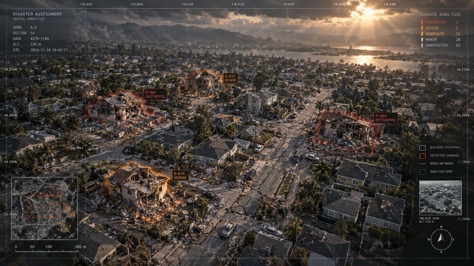
In the aftermath of natural disasters, rapid building assessment is critical. AI enables emergency responders to quickly identify damaged structures, prioritize rescue efforts, and plan reconstruction.
The Human-AI Partnership
It's important to understand that AI efficiency isn't about replacing human expertise—it's about amplifying it. The most successful implementations of AI building detection follow a collaborative model:
- AI handles: Data processing, repetitive analysis, pattern recognition at scale
- Humans focus on: Strategic decisions, creative problem-solving, client relationships, complex judgment calls
This partnership allows professionals to deliver higher-value services to their clients while eliminating the drudgery of manual data processing.
🎯 Key Insight
Organizations that successfully adopt AI don't reduce their workforce—they redeploy their talent to higher-value activities. The result is typically increased revenue, improved client satisfaction, and more engaged employees.
Implementing AI Efficiency: Getting Started
Adopting AI building detection technology is more accessible than many professionals realize. Modern platforms like WetuneAI are designed for immediate use:
- No complex setup required: Cloud-based solutions work right from your browser
- Compatible with existing workflows: Accepts standard drone imagery and orthophoto formats
- Intuitive interfaces: Designed for professionals, not just data scientists
- Immediate results: Start seeing AI-analyzed outputs within minutes
Ready to Experience AI Efficiency?
Join thousands of urban planners, architects, and real estate professionals who are already using AI to transform their workflows. Try WetuneAI for free—no registration required.
Try It Free →Looking Ahead: The Future of AI in Building Analysis
As AI technology continues to evolve, we can expect even greater efficiency gains:
- Predictive analytics: AI will not just analyze current conditions but predict future trends
- Integration with BIM: Seamless connection between AI detection and Building Information Modeling
- Real-time processing: Live analysis as drones capture imagery
- Enhanced 3D modeling: Automatic generation of detailed 3D building models from 2D imagery
The organizations that embrace these technologies today will be best positioned to lead their industries tomorrow.
WetuneAI Team
Geospatial engineers and AI researchers building intelligent drone orthophoto analysis tools for GIS professionals.
Frequently Asked Questions
How does AI improve building detection efficiency?
AI improves building detection efficiency by automating the analysis of drone imagery and orthophotos. What traditionally takes weeks of manual work can now be completed in hours with 95%+ accuracy. AI algorithms can process thousands of images simultaneously, identify building boundaries precisely, and generate detailed reports automatically.
What is the ROI of using AI for building segmentation?
The ROI of AI building segmentation is typically realized within the first 3–6 months. Organizations report 70–80% reduction in analysis time, 40–60% cost savings on labor, and significantly improved accuracy compared to manual methods. For large-scale urban planning projects, this can translate to savings of tens of thousands of dollars.
Can AI replace urban planners and architects?
No, AI is designed to augment, not replace, urban planners and architects. AI handles time-consuming data processing and repetitive analysis tasks, freeing professionals to focus on strategic decision-making, creative design, and complex problem-solving. Think of AI as a powerful assistant that handles the heavy lifting while you provide the expertise.
How accurate is AI building detection compared to manual methods?
AI building detection typically achieves 95–98% accuracy, which is comparable or superior to manual methods, especially for large datasets. AI maintains consistent accuracy across thousands of images without fatigue, whereas human accuracy can decline over long analysis sessions. Additionally, AI can detect subtle patterns and features that might be missed by the human eye.
What types of projects benefit most from AI building detection?
AI building detection delivers the greatest value for large-scale projects including: city-wide urban planning initiatives, construction progress monitoring, real estate portfolio analysis, disaster damage assessment, infrastructure planning, and environmental impact studies. Any project involving analysis of hundreds or thousands of buildings can benefit significantly from AI automation.
How long does it take to implement AI building detection?
With WetuneAI, you can start using AI building detection immediately. Our cloud-based platform requires no installation or complex setup. Simply upload your drone imagery or orthophotos, and the AI begins processing within minutes. Most users are generating their first AI-analyzed results within an hour of signing up.
Related Articles
Why Vertical AI Wins: The Case for Domain-Specific Building Detection
Discover why specialized AI models outperform general-purpose solutions for building detection and segmentation.
Business AnalysisAI vs Manual Building Detection: Cost Comparison
Is AI worth the investment? We break down the real costs of manual vs automated building detection with ROI analysis.