Tata Power just did something that every infrastructure operator should pay attention to. They built an end-to-end AI solar panel inspection system using AWS SageMaker for custom computer vision model training and Amazon Bedrock for GenAI-powered analysis — and they open-sourced the architecture.
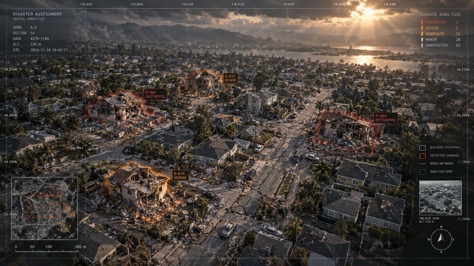
The significance goes beyond solar. This is a reference architecture for how enterprise infrastructure inspection works in 2026: drones capture imagery, AI detects assets and defects, and GenAI translates the output into action. And it all starts with one fundamental capability: knowing where every building and structure is.
The Tata Power Architecture: Three Layers
The system is elegantly modular. Understanding it helps you see how the same pattern applies to any infrastructure inspection use case.
Layer 1: Drone Imagery Collection
Tata Power flies commercial drones over their solar farms on a regular schedule. Each flight captures high-resolution RGB and thermal imagery of thousands of panels. The key requirement: consistent flight paths and altitude so that images are geometrically comparable across inspections. This is the same flight planning discipline used in construction site monitoring and building surveys.
Layer 2: AWS SageMaker — Custom Vision Models
Here's where most companies stumble. Off-the-shelf AI models aren't trained for the specific panel types, mounting angles, and lighting conditions of a particular solar farm. Tata Power used SageMaker to train custom object detection models on their own labeled dataset of panel defects: micro-cracks, hotspots, delamination, soiling, and vegetation encroachment.
SageMaker handles the heavy lifting — GPU instances, distributed training, hyperparameter tuning — so the team focuses on labeling data and evaluating results. The trained model then runs inference on new drone imagery, flagging every panel that needs attention.
Layer 3: Amazon Bedrock — From Detection to Decision
This is the innovation that makes the system operationally useful, not just technically impressive. After the vision model detects a defect, Bedrock's GenAI analyzes the context — panel location, defect type, severity, weather history — and generates a natural-language maintenance recommendation.
Instead of a data scientist interpreting "Panel #4782: hotspot detected, confidence 0.94", the maintenance team receives: "Panel #4782 in Block C has a Class 2 hotspot likely caused by partial shading from the adjacent structure. Clean the panel surface and trim vegetation within 2 weeks to prevent permanent cell damage."
The Missing Foundation: Building and Rooftop Detection
There's a step that Tata Power's architecture assumes but doesn't explicitly mention: before you can inspect solar panels, you need to know exactly where they are.
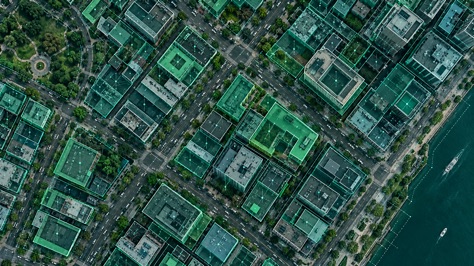
This is where AI building detection enters the pipeline. Step zero of any solar inspection system is extracting precise roof and ground-mount polygons from aerial imagery. You need to know:
- Which rooftops have solar panels installed
- The exact boundary of each solar array
- The orientation and slope of each panel group
- Shading from adjacent buildings and vegetation
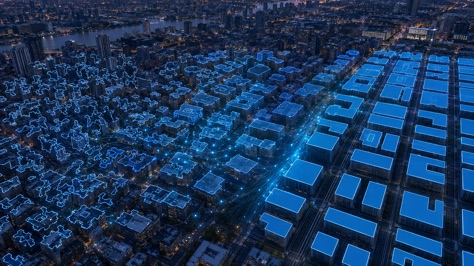
AI building detection answers all of these. It's the universal first step for any infrastructure inspection workflow — whether you're inspecting solar panels, wind turbines, power lines, or building facades. You can't inspect what you haven't located.
As we explored in our guide to calculating building footprints, accurate roof polygon extraction is the difference between a useful inspection system and one that misses 20% of the assets.
Why This Matters Beyond Solar
The Tata Power architecture isn't just about solar panels. Swap "solar panel defects" for "wind turbine blade erosion" or "power line insulator damage" or "bridge concrete spalling" and the pipeline is identical:
| Infrastructure Type | What Gets Detected | AI Model Needed |
|---|---|---|
| Solar Farms | Panel cracks, hotspots, soiling | Defect detection (thermal + RGB) |
| Wind Turbines | Blade erosion, leading-edge damage | Surface anomaly detection |
| Power Lines | Insulator damage, vegetation encroachment | Corridor monitoring |
| Building Facades | Cracks, water damage, spalling | Structural defect classification |
| Bridges & Dams | Concrete deterioration, joint failure | Change detection over time |
Every one of these starts with the same Step 0: AI building and structure detection to locate the assets in drone or satellite imagery. The inspection model is the application layer — building detection is the foundation.
From Tata Power to Your Operation: The Democratization Angle
The most important part of Tata Power's announcement isn't the technology — it's the accessibility. They didn't build a proprietary black box. They documented the architecture using managed AWS services that any organization can provision.
A mid-size solar operator doesn't need a team of ML engineers to replicate this. The building blocks are:
- $2,000-5,000 drone with thermal camera capability
- Cloud-based AI building detection for rooftop and panel localization
- SageMaker for custom defect model training (or use a pre-trained model)
- Bedrock for GenAI report generation
Total setup: under $10,000. Annual operating cost: roughly $500-1,000/month in AWS services for a mid-size operation. Compare that to $50,000-100,000/year for manual inspection crews — and the AI system catches defects the human eye misses.
Frequently Asked Questions
Start With Accurate Building Detection
Upload drone or aerial imagery. Get precise building and rooftop footprints in minutes — the foundation for any AI inspection system.
Try WetuneAI for Free →