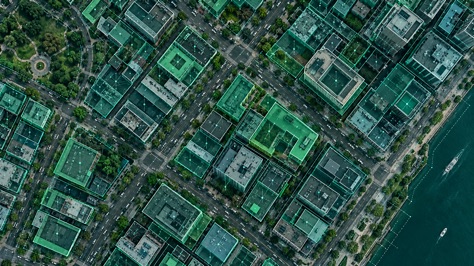
Go back to GEOINT 2023, and AI was a sideshow. A few vendors had "AI-powered" stickers on their booths. Keynotes mentioned machine learning in passing. The real action was still in satellites, sensors, and human analysts poring over imagery frame by frame.
GEOINT 2026 was different. AI didn't just have a presence — it was the organizing principle of the entire conference. Day one featured NASA announcing the first geospatial AI foundation model operating in orbit. Commercial GEOINT sessions overflowed with defense contractors and allied intelligence officers. And building detection — once a niche GIS task — was discussed alongside satellite tasking and signals intelligence as a core GEOINT capability.
Three Announcements That Changed the Conversation
1. NASA Prithvi Goes Orbital
NASA's Prithvi model — originally a ground-based geospatial AI foundation model trained on Harmonized Landsat and Sentinel-2 data — is now operating onboard satellites. This means AI inference happens in orbit: the satellite captures an image, runs building detection and land classification on-board, and transmits results rather than raw pixels.
Why this matters for building detection:
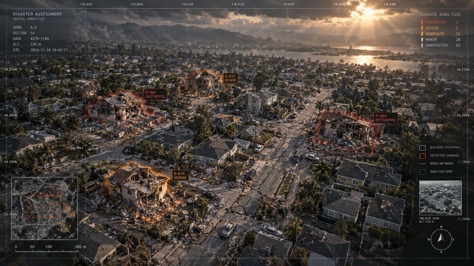
An orbiting AI model that can extract building footprints in real time eliminates the "downlink → process → analyze" pipeline. A disaster zone can be mapped for building damage within minutes of a satellite pass, not hours. Forward operating bases can be detected and tracked without a human ever seeing the raw image.
2. Commercial GEOINT Goes Mainstream
The National Geospatial-Intelligence Agency (NGA) used GEOINT 2026 to expand its commercial GEOINT procurement programs. The message was clear: the government no longer needs to own the satellites or build the AI to get world-class geospatial intelligence. Commercial vendors — from satellite operators to AI analytics companies — are now formally integrated into the intelligence production pipeline.
This is a direct opportunity for AI building detection platforms. If a commercial AI company can extract building footprints faster and more accurately than an in-house analyst team, the procurement door is open. Accuracy and speed — not clearance level or corporate pedigree — are the new barriers to entry.
3. Allied Integration Standards Emerge
NATO and Five Eyes partners used GEOINT 2026 to advance shared standards for AI-generated geospatial data. Building footprints, in particular, were highlighted as a "common operating picture" data layer that every allied nation needs — and that commercial AI can produce consistently across theaters.
The implication: a building footprint extracted by a commercial AI platform in one country can now feed directly into the intelligence systems of another, with no manual conversion or format translation. This interoperability is what turns building detection from a single-nation capability into an alliance-wide force multiplier.
The Building Detection Use Cases That Defense Actually Cares About
It's easy to assume that "defense building detection" means spotting enemy bases. It does — but that's only about 20% of the actual demand. The GEOINT 2026 sessions revealed a much broader spectrum:
Based on session topics and vendor presence at GEOINT 2026
Humanitarian assistance and disaster response (HA/DR) is actually the largest use case. When a cyclone hits Bangladesh or an earthquake strikes Turkey, the first thing responders need is a map of what buildings existed before the disaster and which ones are damaged now. AI building detection delivers this in hours.
Infrastructure mapping — roads, bridges, power plants, ports — is the second-biggest. Building detection AI is the first step: you extract all structures, then classify them. An adversary's power grid isn't just power lines; it's the buildings that house transformers and control systems.
What Makes Commercial AI Competitive in Defense
The GEOINT community has historically been skeptical of commercial AI. The objections were predictable: "not secure enough," "not accurate enough for military decisions," "we have our own systems."
GEOINT 2026 showed those objections crumbling. Three factors are driving the shift:
- Accuracy parity. Commercial AI building detection now matches or exceeds the accuracy of military analyst teams on building extraction tasks — and does it thousands of times faster.
- Procurement reform. The NGA and allied agencies have streamlined the process for buying commercial data and analytics. "FedRAMP and done" is replacing "build it ourselves over 5 years."
- Satellite democratization. When a startup can task a satellite to image any location on Earth within 24 hours, the government doesn't need to own the constellation — just the analytics that make sense of the imagery.
The new defense procurement math:
A traditional military analyst team can manually digitize roughly 200-500 building footprints per day. A commercial AI platform extracts 100,000+ in the same time frame, with higher consistency. The cost per building drops from dollars to fractions of a cent. At that ratio, "build in-house" stops making sense.
The Prithvi Effect: What an Orbital AI Model Means for the Industry
NASA's Prithvi deployment is more than a technical achievement — it's a market signal. When a government agency puts an AI model in space specifically for geospatial analysis, it validates the entire category. Building detection, land cover classification, change detection — these are no longer experimental. They're operational capabilities that merit orbital deployment.
The ripple effects will reach commercial providers quickly. Prithvi is a foundation model — it does general-purpose geospatial analysis. But the defense community needs specialized, high-accuracy tools for specific tasks. An orbital foundation model that identifies "there are structures here" still needs a ground-based commercial AI that says "these structures, with this level of precision, for this specific intelligence requirement."
This layered architecture — orbital foundation models for broad detection, commercial specialized AI for precision analysis — was a recurring theme throughout GEOINT 2026. It's the same pattern we've seen in Google's Open Buildings dataset: broad, free models covering the planet, supplemented by high-resolution commercial solutions where precision matters.
What Comes Next: 2027 and Beyond
GEOINT 2026 didn't just showcase what's possible — it mapped out what's next. Three trajectories are clear:
- Real-time building change alerting. Continuous satellite monitoring + AI building detection = knowing within hours when a new structure appears anywhere on Earth. This capability was described as "operationally necessary within 18 months" by multiple speakers.
- Multi-sensor fusion. Combining satellite imagery with drone footage, SAR (synthetic aperture radar), and thermal imaging to detect buildings that are deliberately concealed. AI is the only way to fuse these heterogeneous data sources at scale.
- Democratization of GEOINT. Small nations and even municipal governments are gaining access to the same AI building detection tools that superpowers use. The technology that mapped Baghdad in 2003 can now map a flood-prone neighborhood in Bangladesh — for a fraction of the cost.
As we covered in our digital twin guide, the line between defense GEOINT and civilian smart city applications is blurring. The same AI building detection that tracks adversary infrastructure also helps city planners model flood risk. The technology doesn't care about the use case — it cares about the data.
Frequently Asked Questions
Building Detection at Defense-Grade Speed and Accuracy
Whether you're mapping disaster zones or monitoring infrastructure, get accurate building footprints from drone and satellite imagery in minutes.
Try WetuneAI for Free →